

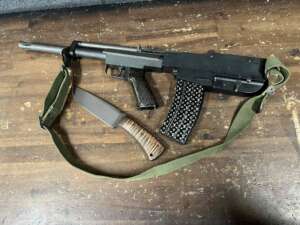
Before AR pistols were cool. Before the Honey Badger. Before SIG’s Rattler. Before anyone even knew what a “PDW” was—there was this weird, brilliant, completely ahead-of-its-time gun that almost nobody remembers.
The Bushmaster Arm Pistol.
And if you’ve never heard of it, you’re not alone. Only about 2,100 were ever made between 1977 and 1990. Most got beat to hell as truck guns and survival weapons. The ones that survive? They’re going for $2,000 to $5,500 depending on condition, and collectors are starting to wake up to how significant this thing actually was.
Here’s the story: A Vietnam vet and Special Forces officer named Mack Gwinn Jr. comes home from the war with an idea. He gets his hands on the patents for a failed Air Force survival weapon project, redesigns it for 5.56mm, makes it work with standard AR-15 magazines, and creates what might be the first true personal defense weapon ever made for the civilian market.
It’s a bullpup. It’s got a rotating pistol grip. It’s barely 20 inches long but shoots full rifle ballistics. And it completely flopped commercially because the market in 1977 had absolutely no idea what to do with it.
But here’s the thing—this gun invented the entire PDW category. Every modern compact rifle-caliber pistol owes something to what Mack Gwinn figured out almost 50 years ago.
And the wildest part? In 2024, just months before he passed away at 79, Gwinn brought it back. The Hydra BMP-23 is his final refinement of the design that started it all.
This is the complete story of the gun that was too cool for its own time—and why serious collectors are finally giving it the respect it deserves.
Table of Contents:
- What the Hell is a Bushmaster Arm Pistol?
- The Origin Story: From Air Force Reject to Gwinn’s Vision
- What Made It So Damn Unique
- The Rise and Fall of Gwinn Firearms
- The Different Versions (And Why Some Are Worth $20K)
- Pop Culture Appearances (Spoiler: Not Many)
- Collector’s Guide: What to Look For and What to Pay
- What’s It Actually Like to Shoot?
- The 2024 Revival: Hydra BMP-23
- Why This Gun Actually Matters
- Should You Buy One?
- FAQ: Everything Else You’re Wondering
What the Hell is a Bushmaster Arm Pistol?
Alright, let’s start with the basics.
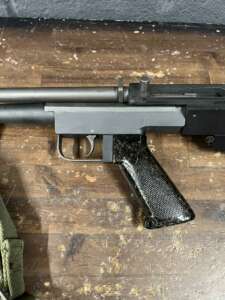
The Bushmaster Arm Pistol (also called the Gwinn Arm Pistol, depending on who made it and when) is a bullpup-configured 5.56mm pistol that looks like something out of a sci-fi movie but was actually designed in the mid-1970s.
Here’s what you need to know:
- Caliber: 5.56x45mm NATO (same as your AR-15)
- Barrel: 11.5 inches
- Overall length: 20.6 inches (shorter than most AR pistols today)
- Weight: 6.25 lbs unloaded
- Magazine: Standard AR-15 mags (20 or 30-round)
- Action: Gas-operated, rotating bolt
- Made: 1977-1990 (~2,100 total)
- Worth today: $2,000-$5,500+ depending on condition
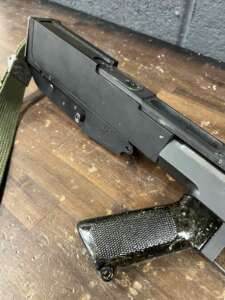
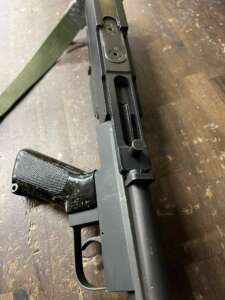
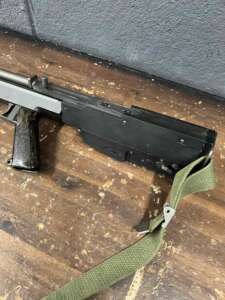
It’s a bullpup, which means the magazine and action are behind the trigger. That’s how you get an 11.5-inch barrel into a package barely over 20 inches long. And it’s got this wild rotating pistol grip that swivels 40 degrees so you can adjust the angle for different shooting positions.
The genius move? It takes standard AR-15 magazines. In the 1970s, when everyone was designing proprietary magazine systems that were expensive and hard to find, Gwinn just said “screw it, let’s use AR mags.” Brilliant.
Only problem? The market in 1977 had no idea what to do with a compact, rifle-caliber pistol. AR-15s themselves were still pretty niche. The idea of a “personal defense weapon” didn’t exist yet. So despite being innovative as hell, it never sold.
Today, collectors are finally waking up to how significant this thing was. It’s the gun that invented the PDW category—it just had the bad luck of showing up 30 years too early.
The Origin Story: From Air Force Reject to Gwinn’s Vision
Every great gun has a story. This one starts with the U.S. Air Force, a failed survival weapon project, and a Special Forces officer who saw potential where everyone else saw junk.
The B-58 Hustler Connection: Why This Gun Existed
Before we dive into the Bushmaster Arm Pistol, you need to understand where this whole concept came from. And that story starts with one of the most badass—and dangerous—aircraft ever built: the Convair B-58 Hustler.
The B-58 Hustler: America’s First Supersonic Bomber
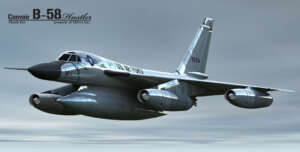
The B-58 Hustler was a Cold War marvel that pushed every boundary of aviation technology in the late 1950s and early 1960s.
The specs:
- Speed: Mach 2+ (over 1,300 mph)
- Altitude: 60,000+ feet
- Mission: Nuclear strike deep into Soviet territory
- Crew: 3 (pilot, navigator, defensive systems operator)
- Service: 1960-1970 (U.S. Air Force Strategic Air Command)
This wasn’t just fast—it was the fastest operational bomber ever built. Even today, no bomber flies faster than the B-58 did 60+ years ago.
The problem: Flying at Mach 2 at 60,000 feet created a survival challenge nobody had solved before.
The Escape Capsule: Revolutionary Survival Technology
At Mach 2, traditional ejection seats were a death sentence. The wind blast alone would kill you instantly—your body would be ripped apart by 1,300 mph winds before your parachute even deployed.
The Air Force needed something completely different.
Enter the Stanley Aviation B-58 escape capsule—the world’s first operational aircraft escape pod.
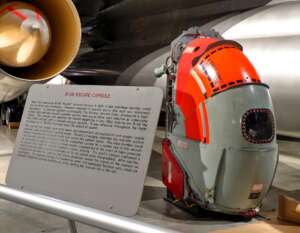
How the B-58 Escape Capsule Worked
Instead of ejecting into the wind blast, each crew member sat inside an individual encapsulated ejection system that worked like this:
- Emergency Activation:
- Crew member pulls ejection handle
- Clamshell doors close around the seat (0.5 seconds)
- Creates a sealed, protective capsule
- Ejection:
- Explosive charges fire the entire capsule out of the aircraft
- Capsule tumbles away from the bomber
- Crew member is completely enclosed and protected
- Descent:
- Drogue parachute deploys to stabilize capsule
- Main parachute deploys at safe altitude
- Capsule descends like a space capsule
- Water Landing:
- Capsule is watertight and floats
- Transforms into a life raft
- Contains survival gear, radio, and supplies
- Survival:
- Crew member can survive inside capsule for days
- Protection from elements, exposure, and hypothermia
- Built-in flotation system
The Survival Gun Problem
Here’s where the Bushmaster Arm Pistol story begins.
Each B-58 escape capsule contained extensive survival gear:
- Emergency rations (food and water)
- First aid kit
- Radio beacon
- Flares and signaling equipment
- Survival manual
- Survival weapon
The challenge: What kind of gun do you pack in a cramped escape capsule for a crew member who might land anywhere from the Arctic to the jungle to the ocean?
Enter the Colt IMP-221: The Original Concept
In the early 1960s, Colt developed the IMP-221 (Individual Multi-Purpose weapon, .221 caliber) specifically for the B-58 escape capsule program.
The IMP-221 concept:
- Bullpup configuration (maximum barrel length, minimum overall length)
- Rotating pistol grip (could be fired from multiple positions)
- Detachable magazine
- Chambered in .221 Fireball (compact, powerful varmint cartridge)
- Overall length: Under 20 inches
The innovation: By placing the action behind the trigger (bullpup design) and using a rotating grip, Colt created a rifle-caliber weapon that could fit in the tight confines of an escape capsule.
What happened: The Air Force tested it, but the B-58 program was already being phased out by the mid-1960s. The IMP-221 never entered production.
But the patent and design didn’t die.
The Colt IMP-221: The Gun That Almost Was
After Vietnam, the Air Force had a problem. Pilots and aircrews needed a compact survival weapon—something small enough to fit in an ejection seat or survival kit, but effective enough to actually defend yourself if you got shot down in hostile territory.
The M1 Carbine they’d been using was outdated and too long. So they contracted with Colt to develop something new: the “Individual Multi-Purpose” weapon, or IMP-221.
Colt’s answer was radical for the time—a bullpup design chambered in .22 caliber. The idea was to maximize barrel length while keeping the overall package tiny. The Air Force even gave it an official designation: GUU-4/P.
And then… nothing. Budget cuts. Changing priorities. The program got cancelled before it ever went anywhere. Colt moved on to more profitable projects, and the IMP-221 patents just sat there gathering dust.
That’s where Mack Gwinn Jr. comes in.
Mack Gwinn Jr.: The Man Who Saw the Future
Mack W. Gwinn Jr. (1944-2024)
Vietnam vet. U.S. Army Special Forces. Captain. The kind of guy who’d actually used guns in combat and knew what worked and what was bullshit.
After he got back from Vietnam, Gwinn couldn’t shake this feeling that there was a gap in the market. Soldiers, pilots, vehicle crews, cops—they all needed something between a pistol and a rifle. Compact enough to actually carry and store, but powerful enough to be effective at real distances.
When he heard about Colt’s abandoned IMP-221 project, he saw exactly what he’d been looking for.
Here’s what Gwinn did:
In the early 1970s, he acquired the patent rights to the IMP-221. Then he made some critical changes:
- Rechambered it for 5.56mm NATO
The .22 caliber was cute for survival situations, but useless for serious defensive use. 5.56mm—the same round as the M16—gave it real stopping power.
- Made it work with AR-15 magazines
Instead of designing some proprietary magazine system (expensive, hard to find, limits sales), Gwinn just made it take standard AR mags. Cheap, available everywhere, already proven reliable.
- Added the rotating pistol grip
That 40-degree swivel grip wasn’t on the original Colt design. That was pure Gwinn innovation.
- Refined the bullpup layout
Improved ergonomics, better trigger linkage, more practical for actual use.
His vision was simple: Create the ultimate personal defense weapon. Compact enough for a vehicle or aircraft. Powerful enough for real combat. Reliable enough to bet your life on.
In the mid-1970s, Mack Gwinn Jr. founded Gwinn Firearms Company in Bangor, Maine, and started building what would become the Bushmaster Arm Pistol.
The gun that was 30 years ahead of its time.
What Made It So Damn Unique
Let’s talk about why this thing was so innovative—and why it’s still cool as hell almost 50 years later.
The Bullpup Design
If you’re not familiar with bullpups, here’s the deal: You move the magazine and action behind the trigger. This lets you pack a full-length barrel into a way shorter overall package.
The advantage is huge:
- Bushmaster Arm Pistol: 11.5″ barrel, 20.6″ overall length
- Standard AR-15: 16″ barrel, 32″+ overall length
You’re getting nearly 12 inches less gun while keeping similar ballistic performance. For a vehicle gun, survival weapon, or something you need to store in tight spaces, that’s massive.
But bullpups have trade-offs:
✅ Super compact – Perfect for vehicles, aircraft, confined spaces
✅ Maneuverable – Way easier to handle in tight quarters
✅ Full rifle ballistics – That 11.5″ barrel performs like a short-barreled rifle
✅ Balanced weight – Weight is centered over your grip instead of way out front
❌ Weird ergonomics – The trigger is way forward of the action, so you get a long, mushy trigger pull
❌ Ejection port by your face – Spent brass ejects close to your head (sucks for lefties)
❌ Awkward reloads – Magazine well is behind the grip, so reloading feels unnatural
❌ No good cheek weld – You can’t shoot it like a traditional rifle
In the 1970s, American shooters had basically zero experience with bullpups. This thing asked you to completely rethink how you handled a firearm. That was a tough sell.
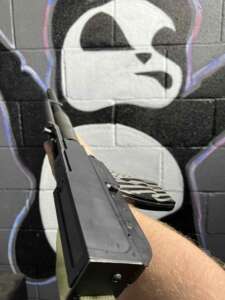
The Rotating Pistol Grip (The Coolest Feature Nobody Talks About)
Here’s what makes the Bushmaster Arm Pistol truly unique: that rotating pistol grip.
The grip swivels about 40 degrees and locks into multiple positions. You can adjust the angle based on how you’re shooting or carrying it.
Why does this matter?
- Versatility: Pilot in an ejection seat? Adjust the grip. Shooting from a vehicle? Different angle. Standing, prone, seated—you can find a comfortable position.
- Compact carry: Different grip angles let you carry it in different holsters or storage configs.
- Multiple deployment options: You can draw and fire from various positions without repositioning your hand.
- Confined spaces: In a vehicle or aircraft, being able to adjust that grip angle means you can actually get the gun into action even in cramped quarters.
No other production firearm has ever done this. It was a clever solution to the challenge of making a truly versatile PDW, and it’s one of those features that makes you go “holy shit, that’s smart” when you actually handle one.
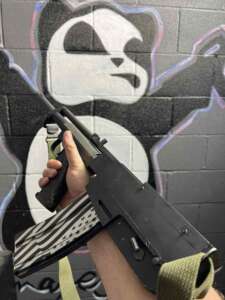
The Specs (For all us Nerds)
| Specification | Details |
| Manufacturer | Gwinn Firearms Company (1977-1990) |
| Designer | Mack Gwinn Jr. |
| Caliber | 5.56x45mm NATO |
| Action | Gas-operated, rotating bolt |
| Barrel Length | 11.5 inches |
| Overall Length | 20.6 inches |
| Weight (Unloaded) | 6.25 lbs |
| Weight (Loaded, 30rd) | ~7.5 lbs |
| Magazine | Standard M16/AR-15 (20 or 30-round) |
| Sights | Fixed front post, flip-up rear aperture |
| Rate of Fire (Select-Fire) | ~600 rounds/min |
| Muzzle Velocity | ~2,700 fps (55gr) |
| Effective Range | 200-300 yards |
| Materials | Aluminum receiver, steel barrel |
| Finish | Black anodized aluminum, parkerized steel |
How It Works
The operating system is basically a modified AR-15 setup adapted for the bullpup configuration. Gas-operated, rotating bolt, similar principles—just laid out differently.
The genius part? Standard AR-15 magazines.
While other innovative firearms in the ’70s and ’80s were using proprietary mags (expensive, hard to find, limited capacity options), Gwinn just said “let’s use AR mags.” You could run 20-rounders, 30-rounders, even drum mags if you wanted.
This decision alone made the Bushmaster Arm Pistol way more practical than most of its competitors.
The Rise and Fall of Gwinn Firearms
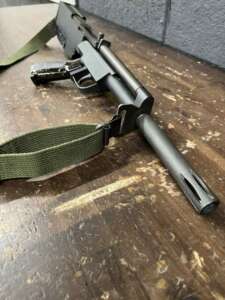
The Bushmaster Arm Pistol had a 13-year production run and produced only about 2,100 units total. Here’s how it all went down.
The Early Years (1977-1985): Small-Scale Production
Gwinn Firearms Company was a small operation in Bangor, Maine. We’re talking boutique-level manufacturing here—maybe 100-200 units per year, lots of hand-fitting, variable quality control.
Early production characteristics:
- Limited production capacity
- Hand-fitted parts (quality varied unit to unit)
- Each gun got individual attention
- Relatively high prices due to low volume
- Early “Gwinn Firearms” marked units (most collectible today)
The gun press was intrigued. Articles started appearing in magazines. Collectors and enthusiasts were curious. But sales? Slow.
The problem wasn’t the gun—it was the timing.
In the late ’70s and early ’80s, AR-15s themselves were still pretty niche. The idea of a compact, bullpup PDW was just too far ahead of the market. Most gun buyers wanted something conventional—a pistol or a rifle, not this weird hybrid thing.
Peak Production (1985-1988): Growing Awareness
By the mid-’80s, the Bushmaster Arm Pistol was gaining some recognition. More magazine features. Word-of-mouth among collectors. A small but dedicated cult following.
Production increased slightly. Quality control improved as manufacturing processes were refined (though hand-fitting remained common).
But Gwinn Firearms still faced major challenges:
- High manufacturing costs: The bullpup design required precision machining. Each unit was expensive to produce.
- Complex assembly: The rotating grip mechanism, the bullpup layout—it all added complexity and cost.
- Quality control issues: With hand-fitted parts and small-scale production, consistency was tough. Some units were excellent. Others were… rough.
- Limited marketing budget: Small company, couldn’t afford big ad campaigns.
- Niche market: The Arm Pistol appealed to a tiny segment of gun buyers.
Despite growing interest, Gwinn Firearms struggled to turn a profit.
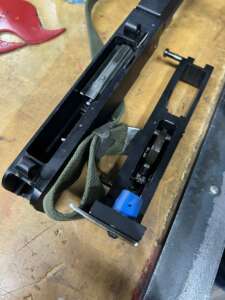
The End (1988-1990): Sold and Forgotten
In 1990, Gwinn Firearms was sold to Quality Products Company, owned by Richard Dyke. The company was renamed Bushmaster Firearms International, and everything changed.
What happened:
- Company stayed in Maine
- Focus shifted from the Arm Pistol to AR-15 production
- The Arm Pistol became a legacy product, not the flagship
- Production effectively ceased around 1988 (pistol) and 1991 (rifle variant)
- Last units carried “Bushmaster Firearms International” markings
Why did production stop?
Simple: AR-15s were way more profitable.
The Arm Pistol was expensive to make, sold slowly, and appealed to a niche market. Standard AR-15s were easier to produce, had way higher demand, and offered better profit margins.
Under new ownership, Bushmaster Firearms International became one of America’s major AR-15 manufacturers, producing hundreds of thousands of rifles over the next two decades.
The Bushmaster Arm Pistol? A victim of bad timing and economics. Innovative as hell, but the market just wasn’t ready.
How Many Were Made? (And How Many Survive?)
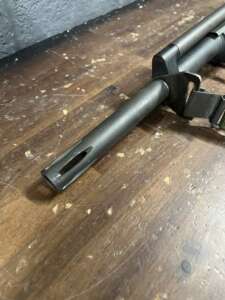
Total production: ~2,100 units (1977-1990)
That includes:
- Semi-auto pistol variants (most common)
- Semi-auto rifle variants with 16″+ barrels (rare)
- Selective-fire (full-auto) variants for military/LE evaluation (extremely rare)
Serial number ranges:
- Early “Gwinn Firearms” marked units: Most collectible, command premium prices
- Later “Bushmaster Firearms” marked units: More common, still valuable
- Selective-fire variants: Extremely rare, NFA-regulated, worth $10K-$20K+ if transferable
How many survive?
Of the 2,100 made, a lot got used hard and eventually scrapped or lost. Best estimate? Maybe 1,000-1,500 still exist.
And of those, most show heavy wear. Pristine examples are exceptionally rare. Complete guns with original box and paperwork? Museum-quality unicorns.
This scarcity is exactly why values have been climbing. With fewer than 1,500 likely surviving, and only a fraction in excellent condition, the Bushmaster Arm Pistol has quietly become one of the most undervalued collectibles in the firearms world.
What’s It Actually Like to Shoot?
Alright, let’s talk about the real-world experience of actually shooting one of these things.
First Impressions
It’s front-heavy. With that 11.5-inch barrel and gas system extending forward, the Arm Pistol is noticeably nose-heavy. One-handed shooting? Forget it. This is a two-handed weapon despite the pistol classification.
The rotating grip is weird at first. It takes some getting used to. Most shooters find one preferred position and leave it there, but the adjustability is cool when you need it.
That bullpup trigger is… not great. Long, mushy, 8-10 pound pull. It’s the nature of bullpup triggers—the linkage is long, so you lose crispness. This isn’t a precision weapon.
But damn, it’s compact. When you first pick one up, the size is striking. It’s hard to believe you’re holding a rifle-caliber firearm barely 20 inches long.
Shooting Position and Ergonomics
The weight and bulk make one-handed shooting impractical except at very close range.
The rotating grip actually helps: You can find a comfortable angle for different shooting stances—seated in a vehicle, prone, standing. It’s not a gimmick.
Cheek weld is awkward: The bullpup configuration doesn’t allow for a traditional rifle cheek weld. You’re essentially shooting it like a large pistol with both hands, or tucking it awkwardly against your shoulder.
Recoil comes straight back: The bullpup design means recoil is directed straight into your hands and arms rather than up and back like a traditional rifle. This actually helps with control.
Accuracy
You’re looking at 3-4 MOA typical. Don’t expect precision rifle accuracy. The heavy, mushy trigger and awkward ergonomics limit precision. Most shooters can achieve 3-4 inch groups at 100 yards from a rest.
But it’s adequate for its intended purpose. For personal defense, survival, or vehicle gun use, the accuracy is fine. You can reliably hit man-sized targets at 200 yards.
The trigger is the limiting factor. That 8-10 pound pull with significant creep makes precise shot placement difficult.
Sights are basic but functional. Fixed front post and flip-up rear aperture. Military-simple. They work, but don’t expect match-grade sight picture.
Ballistics
That 11.5-inch barrel delivers ~2,700 fps with 55-grain ammo. This is full rifle performance, comparable to M4 carbines with similar barrel lengths.
You’re getting full rifle ballistics from a compact package. The 5.56mm cartridge performs nearly identically to longer-barreled rifles at typical defensive distances (inside 200 yards).
But it’s LOUD. The short barrel produces significant muzzle blast and flash. Expect a fireball with each shot, especially in low light. Hearing protection is absolutely essential.
Reliability
Generally reliable with quality ammo. When properly maintained and fed quality ammunition (Federal, Winchester, Remington), the Arm Pistol functions reliably.
But quality varied. Due to hand-fitted production, some examples are flawless, others had feeding or extraction issues from the factory.
Magazine compatibility is excellent. Standard AR-15 magazines (USGI, Magpul, Lancer) all work reliably. This is one of the gun’s greatest strengths.
The gas system can be finicky. The bullpup gas system is more sensitive to ammunition variations than a standard AR-15. Underpowered or overpowered loads can cause cycling issues.
Common issues:
- Ejection can be erratic (sometimes straight back, sometimes at odd angles)
- Some units had feeding issues with certain bullet profiles or worn magazines
- Rotating grip mechanism can loosen over time (needs periodic tightening)
- Parts availability is a nightmare if something breaks
Recoil and Control
Moderate recoil. The 5.56mm cartridge from a 6+ pound gun produces moderate recoil—manageable for most shooters.
Bullpup design puts recoil straight back. Rather than muzzle rise, you feel the recoil as a straight push. This actually makes follow-up shots easier once you get used to it.
Muzzle rise is minimal. The weight and bullpup configuration keep muzzle rise under control. Fast follow-up shots are possible.
Not punishing to shoot. Even after 100+ rounds, the Arm Pistol isn’t fatiguing in terms of recoil. The weight and ergonomics are more tiring than the recoil itself.
The 2024 Revival: Hydra BMP-23 {#modern-revival}
Here’s where the story gets really cool. In 2024, just months before Mack Gwinn Jr. passed away at 79, his vision returned—reimagined for the modern era.
Meet the BMP-23
The Hydra BMP-23 is a modern recreation of the Bushmaster Arm Pistol, manufactured by Hydra Weaponry, a company Mack Gwinn founded in his later years.
It’s the same concept, refined with 40+ years of feedback and modern manufacturing:
- Modern CNC machining (better quality control than the hand-fitted originals)
- Same bullpup PDW concept
- Improved materials and construction
- Still chambered in 5.56x45mm NATO
- Still uses standard AR-15 magazines
- Available in pistol and rifle configurations
The BMP-23 proves that Gwinn never stopped believing in his original vision. Even in his 70s, he was refining the design that defined his career.
What’s Better About the BMP-23?
Better quality control: Modern CNC machining ensures consistent tolerances and fit. Every BMP-23 is built to the same spec—no more hand-fitted variability.
Improved trigger: Still a bullpup trigger with inherent limitations, but significantly better than the original. Lighter pull weight (6-7 lbs vs. 8-10 lbs) and less creep.
Modern materials: Improved aluminum alloys, polymer components where appropriate, better coatings (Cerakote options available).
Picatinny rails: Top rail for optics and accessories. The original only had fixed iron sights.
Improved ergonomics: Refined grip angle, better magazine release placement, improved controls based on decades of user feedback.
Better finish options: Cerakote in multiple colors, more durable than the original anodizing and parkerizing.
Still uses standard AR-15 magazines: The brilliant decision from 1977 carries forward—no proprietary magazines required.
BMP-23 vs. Modern AR Pistols
More compact: Bullpup design is shorter than comparable AR pistols
Unique/conversation piece: Nobody else at the range will have one
Heavier than polymer AR pistols: 5.5 lbs vs. 4-5 lbs for lightweight AR pistols
Trigger not as good: Even improved, bullpup triggers can’t match quality AR triggers
Nostalgia factor: If you love firearms history, the BMP-23 connects you to the PDW pioneer
More expensive: $1,200-$1,500 vs. $600-$1,000 for budget AR pistols
Magazine compatibility: Shares magazines with your AR-15s (huge advantage)
Why This Gun Actually Matters
The Bushmaster Arm Pistol didn’t achieve commercial success. But its influence on firearms design? Undeniable.
It Invented the Modern PDW Category
The Bushmaster Arm Pistol proved that a rifle-caliber firearm could be packaged in a truly compact form factor. This concept—full-power cartridge in a pistol-sized package—became the foundation of the modern PDW category.
Designs it influenced:
- FN P90 (1990) – Bullpup PDW in 5.7x28mm
- H&K MP7 (2001) – Compact PDW in 4.6x30mm
- SIG Rattler (2019) – Ultra-compact 5.56mm pistol
- Honey Badger (2011) – Compact .300 Blackout PDW
- Modern AR pistols – The entire category owes a debt to the Arm Pistol
The Bushmaster Arm Pistol proved the concept worked. Later designs refined it, but Gwinn showed it was possible in 1977.
It Pioneered AR Pistol Concepts
Today, AR-15 pistols are one of the fastest-growing segments of the firearms market. Compact, powerful, versatile—they’re everywhere.
What the Arm Pistol proved:
- Compact 5.56mm platforms are practical and effective
- AR-15 magazine compatibility is essential for success
- There’s a market for vehicle/truck guns
- Bullpup configuration allows maximum compactness
Every modern AR pistol exists because the Bushmaster Arm Pistol proved the concept 45 years ago.
Why It Failed Commercially
Too Ahead of Its Time
In the 1970s and 1980s, the firearms market wasn’t ready.
Market realities:
- AR-15s themselves were still niche
- Bullpup designs were unfamiliar to American shooters
- The PDW concept didn’t exist in civilian consciousness
- Most buyers wanted traditional pistols or rifles, not hybrids
The Arm Pistol was asking shooters to completely rethink what a defensive firearm could be. In 1977, that was too big an ask.
Manufacturing and Marketing Challenges
Small company, limited resources: Gwinn Firearms couldn’t achieve economies of scale
Quality control issues: Hand-fitted parts meant inconsistent quality
High production costs: Complex machining made each unit expensive
Limited marketing budget: Couldn’t afford major ad campaigns
Niche appeal: The Arm Pistol appealed to a tiny segment of buyers
No military adoption: Without military or LE contracts, civilian sales had to carry the entire business—impossible
Mack Gwinn Never Stopped Innovating
After the Arm Pistol, Gwinn continued designing:
M2 .50-cal Quick Change Barrel (QCB): Developed for FN, allowing rapid barrel changes on the M2 Browning—a significant military improvement
90-round helical magazine systems: Innovative high-capacity magazine designs
Founded MGI (Modular Gun Industries): Continued developing modular firearms systems
Founded Hydra Weaponry: His final company, which produced the BMP-23
Continued innovating until his death (2024): Even in his late 70s, Gwinn was refining designs and pushing boundaries
Remembering Mack Gwinn Jr. (1944-2024)
Mack Gwinn Jr. passed away in March 2024 at age 79.
Vietnam veteran. Special Forces officer. Lifelong innovator who never stopped pushing the boundaries of firearms design.
From the Bushmaster Arm Pistol to the BMP-23, his legacy lives on in the PDW category he helped create.
He saw the future of personal defense weapons in 1977. The rest of the world just took 40 years to catch up.
Rest in peace, Captain Gwinn. Your vision lives on.
FAQ: Everything Else You’re Wondering
 What is a Bushmaster Arm Pistol worth?
Bushmaster Arm Pistols typically sell for $2,000-$5,500 depending on condition. Excellent condition examples with original finish and Gwinn Firearms markings command $4,000-$5,500, while well-used examples sell for $2,000-$3,000. Rare selective-fire (full-auto) variants can exceed $10,000-$20,000 if they’re pre-1986 transferable machine guns. Values have increased 30-50% over the past decade and continue climbing.
How many Bushmaster Arm Pistols were made?
Approximately 2,100 Bushmaster Arm Pistols were produced between 1977-1990 by Gwinn Firearms Company and later Bushmaster Firearms International. This includes semi-automatic pistol variants (most common), semi-automatic rifle variants with 16″+ barrels (rare), and a small number of selective-fire variants made for military and law enforcement evaluation (extremely rare). Of the 2,100 produced, an estimated 1,000-1,500 still exist today.
Who designed the Bushmaster Arm Pistol?
The Bushmaster Arm Pistol was designed by Mack Gwinn Jr. (1944-2024), a Vietnam War veteran and U.S. Army Special Forces officer. He based his design on the Colt IMP-221, an abandoned Air Force survival weapon prototype. Gwinn acquired the patent rights in the early 1970s, rechambered it for 5.56x45mm NATO, made it compatible with standard AR-15 magazines, and founded Gwinn Firearms Company to manufacture it. He’s known as “The Father of the PDW” for pioneering the personal defense weapon category.
Is the Bushmaster Arm Pistol still made?
The original Bushmaster Arm Pistol ceased production around 1990. However, Hydra Weaponry introduced the BMP-23 in 2024—a modern recreation of the original design with improved manufacturing, materials, and features. The BMP-23 is currently available through Hydra Weaponry and select dealers, priced at $1,200-$1,500. It represents Mack Gwinn Jr.’s final refinement of his original vision, released just months before his passing in March 2024.
What caliber is the Bushmaster Arm Pistol?
The Bushmaster Arm Pistol is chambered in 5.56x45mm NATO (also accepts .223 Remington). It features an 11.5-inch barrel and uses standard M16/AR-15 magazines (20 or 30-round capacity). The 5.56mm chambering was a significant improvement over the original Colt IMP-221 prototype, which was chambered in .22 caliber. The 11.5-inch barrel delivers approximately 2,700 fps with 55-grain ammunition—full rifle ballistics from a package just 20.6 inches long.
What makes the Bushmaster Arm Pistol collectible?
Several factors make it highly collectible:
Extreme rarity: Only ~2,100 produced, fewer than 1,500 survive
Historical significance: Pioneer of the PDW category, influenced modern designs
Innovative design: Unique bullpup configuration with rotating pistol grip
Mack Gwinn legacy: Designed by a Vietnam veteran and Special Forces officer who became a legendary firearms innovator
Increasing values: Prices have risen 30-50% over the past decade
Condition scarcity: Excellent condition examples are exceptionally rare
Cultural significance: Represents a fascinating “what if” in firearms history—a gun ahead of its time
The Bottom Line
The Gwinn/Bushmaster Arm Pistol never achieved the commercial success Mack Gwinn Jr. envisioned. Only 2,100 were made. Production ended in 1990. For decades, it faded into obscurity—a footnote known only to serious collectors.
But its legacy? Undeniable.
This was the gun that proved a rifle-caliber cartridge could work in a truly compact package. It pioneered the bullpup PDW concept that would influence the FN P90, H&K MP7, SIG Rattler, and countless modern designs. It showed that AR-15 magazine compatibility was the key to success. And it demonstrated that there was a market for compact, powerful personal defense weapons—even if that market wouldn’t fully materialize for another 30 years.
The Bushmaster Arm Pistol invented the modern PDW category. It just had the misfortune of arriving decades before the world was ready for it.
Today, original Bushmaster Arm Pistols are highly sought-after collectibles, commanding $2,000-$5,500+ depending on condition. They represent a fascinating chapter in firearms history—a bold experiment by a Vietnam veteran who saw the future when everyone else was still thinking in terms of carbines and submachine guns.
And with the 2024 introduction of the Hydra BMP-23, released just months before Mack Gwinn’s passing, his vision lives on. The “forgotten PDW” is forgotten no more. Modern shooters can experience the concept Gwinn pioneered in 1977, refined with 40+ years of feedback and modern manufacturing.
Whether you’re a serious collector hunting for an original Gwinn Firearms-marked example, a history enthusiast fascinated by innovative designs that were ahead of their time, or someone considering the modern BMP-23 for actual use, the Bushmaster Arm Pistol story is one worth knowing.
It didn’t change the world overnight.
But it changed it nonetheless.
Mack Gwinn Jr. saw the future in 1977. The rest of us just took 40 years to catch up.
Want to shoot a full auto Gwinn Gun?
You’re in luck! At Damage Factory, we specialize in sourcing hard-to-find firearms for serious collectors. Whether you’re searching for a Bushmaster Arm Pistol, other rare PDWs, or historically significant firearms, we can help.
Want to experience the Gwinn gun and many other rare firearms? Check out our full-auto experience!
📞 Call us: (888) 900-2876
📍 Location: Greenwood Village, CO
Join our collector’s list to get notified when rare firearms like the Bushmaster Arm Pistol become available. We work with auction houses, private collectors, and estate sales to source the firearms you’re looking for.
We also offer:
- Authentication services for rare firearms
- Consignment sales for collectors looking to sell
- FFL transfer services ($55 – lowest in Colorado)
- Expert guidance on building a firearms collection
- Connections to gunsmiths specializing in rare/historical firearms
Contact us today and let us help you find the rare firearms that belong in your collection.
Sources: Firearms News historical research, Shooting Illustrated “Classics” series, American Rifleman archives, Hydra Weaponry product information, Rock Island Auction Company catalog records, GunBroker.com historical sales data, Internet Movie Firearms Database (IMFDB), collector forums and firsthand accounts, firearms patent records, Bushmaster Firearms International company history, Gwinn Firearms Company documentation.
Disclaimer: This article provides historical information about the Gwinn/Bushmaster Arm Pistol for educational and collector purposes. Always verify compliance with federal, state, and local laws before purchasing any firearm. Consult with a qualified firearms attorney if you have legal questions. Values and market information are estimates based on recent sales data and may vary. Damage Factory is not responsible for authentication or condition assessment of firearms purchased from third parties.